ChatGPT Now Recommends Businesses: Optimize Your Website for AI with AEO
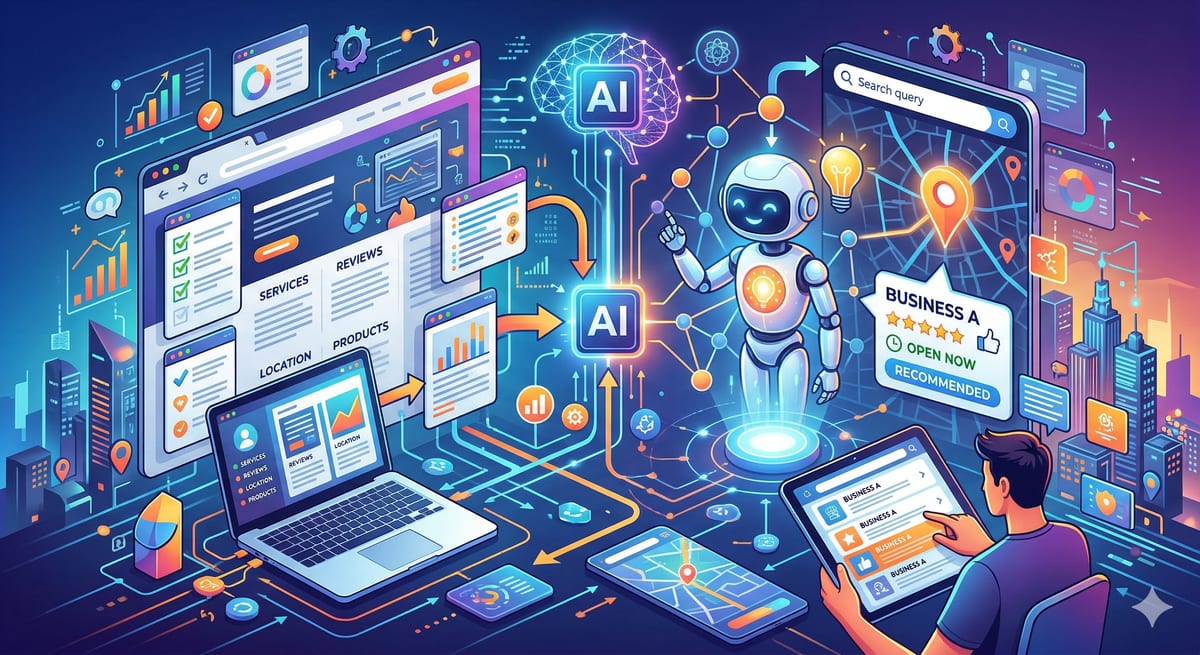
ChatGPT Now Recommends Businesses Directly: A New Era
A quiet but revolutionary change is happening in the digital world. ChatGPT, Perplexity, Google AI Overviews and other AI-powered search engines now directly answer user questions and recommend specific businesses, products, and services by name in their responses. This fundamentally changes the rules of digital marketing.
When a user asks ChatGPT "What is the best web hosting provider?", the AI can directly recommend specific companies. But is your business among these recommendations? This is exactly where AEO (Answer Engine Optimization) comes in.
One of the most overlooked AEO signals is whether your business has a web presence at all. Surprising as it sounds, a significant portion of SMBs still operate without a website — making them completely invisible to AI recommendation engines. EastWeb's research into Romania's hidden digital gap, where 190 successful businesses operate without websites, shows just how large this blind spot remains heading into 2026.
What is AEO (Answer Engine Optimization)?
AEO (Answer Engine Optimization) is the process of optimizing your website and digital presence for AI-powered answer engines. While traditional SEO aims to rank high in Google search results, AEO aims to make AI systems choose you as their direct answer or recommendation.
In traditional SEO, the goal is to appear as high as possible in search engine results pages (SERPs). In AEO, the goal is fundamentally different: ensuring your business is featured in the AI's answer. This is vital in a world where a single answer replaces "10 blue links".
AEO is also known as GEO (Generative Engine Optimization). Both terms serve the same purpose: becoming visible in AI engines.
How Do AI Search Engines Choose Which Businesses to Recommend?
ChatGPT and similar AI systems don't recommend businesses randomly. They make decisions based on specific criteria:
- Structured Data: Sites using JSON-LD and Schema.org markup make it easier for AI to understand content. Organization, Product, FAQ, and HowTo schemas are critically important.
- Content Quality and Authority (E-E-A-T): Google's E-E-A-T criteria are also considered by AI engines.
- Online Reputation and Reviews: Positive reviews on Google My Business, Trustpilot, G2 help AI see you as a trustworthy source.
- Clear, Well-Organized Information: Websites with clear and well-structured content are more easily processed and recommended by AI.
- FAQ and How-To Content: Question-and-answer format content makes it easier for AI to generate direct answers.
- Regular Content Updates: Sites with continuously updated content are considered more reliable by AI.
7 Key Strategies for AEO Optimization
1. Implement Rich JSON-LD Structured Data
Structured data is the foundation of AEO. Add these Schema.org schemas to your website:
- Organization: Company information, logo, contact details
- LocalBusiness: Physical address, business hours, location
- Product/Service: Product and service details, prices, features
- FAQ: Frequently asked questions and answers
- HowTo: Step-by-step guides and instructions
- Review/AggregateRating: Customer reviews and ratings
2. Create Comprehensive FAQ Pages
AI engines love question-and-answer format content. Create comprehensive FAQ sections on every service page and your homepage. Write questions in natural language.
3. Write Clear, Authoritative Content That Directly Answers Questions
Every paragraph of your content can be a potential AI answer:
- State the main idea clearly in the first sentence of each section
- Use concrete data, statistics, and examples
- Share detailed information that demonstrates your industry expertise
- Explain complex topics in simple, understandable language
Security signals matter to AI engines too. A site flagged for vulnerabilities or lacking HTTPS will be deprioritized as a trustworthy source. As attack vectors evolve, staying ahead of threats like prompt injection — one of the fastest-rising web security risks — is now both a cybersecurity requirement and an AEO trust factor.
4. Build E-E-A-T Signals
E-E-A-T (Experience, Expertise, Authoritativeness, Trustworthiness) is the quality indicator AI engines pay most attention to:
- Experience: Share your real experiences, case studies, and success stories
- Expertise: Demonstrate your industry knowledge through blog posts, guides, and technical content
- Authoritativeness: Get featured in industry publications, speak at conferences, win awards
- Trustworthiness: Build trust with SSL certificates, privacy policies, contact information, and customer reviews
5. Maintain Consistent NAP Information
Your NAP (Name, Address, Phone) information must be consistent across all platforms.
6. Earn Quality Backlinks and Mentions
AI engines seriously consider links and mentions from trusted sources. Being mentioned by industry blogs, news sites, and authoritative sources increases the likelihood of AI recommending you.
7. Keep Your Content Fresh and Updated
AI engines prefer current information. Regularly update your blog posts, produce content about new trends, and revise outdated content.
AEO vs SEO: What's the Difference?
AEO and SEO are complementary strategies, not competing ones:
- SEO = Ranking at the top of search results listings.
- AEO = Being the AI's direct answer or recommendation.
- SEO result: Click-through rate depends on search results position. First result gets ~30% CTR.
- AEO result: When AI recommends you, it means 100% visibility.
- Strategy: The two support each other. A good SEO foundation enhances AEO success.
The most effective approach is to implement both strategies in parallel. While SEO drives traffic to your site, AEO makes your brand the trusted source for AI.
Tools for AEO Optimization
- EastWeb Free SEO Audit Tool: Analyze your website's technical SEO and AEO compatibility. Run your free audit now.
- Google Rich Results Test: Verify your JSON-LD structured data is properly recognized.
- Schema Markup Validator: Validate your Schema.org markup and detect errors.
- ChatGPT and Perplexity: Test questions related to your business directly in AI engines.
Conclusion: AEO is the Future of Digital Marketing
AEO is the future of digital marketing. The use of AI-powered search engines is growing rapidly. People no longer just search on Google; they ask direct questions to ChatGPT, Perplexity, and other AI tools.
Businesses that adapt early to this change will gain a significant advantage. With structured data, quality content, strong E-E-A-T signals, and a consistent online presence, you can become the trusted source for AI.
At EastWeb, we offer AEO consulting and optimization services. Run a Free SEO & AEO Audit.
--- ## Frequently Asked Questions ### What exactly is AEO and how is it different from traditional SEO? AEO (Answer Engine Optimization) focuses on making your business the direct answer or recommendation that AI engines like ChatGPT, Perplexity, and Google AI Overviews provide to users. Traditional SEO aims to rank high in a list of search results — users still have to choose. AEO skips that step entirely: the AI picks one answer, and you want to be it. The underlying tactics differ too: AEO prioritizes structured data, authoritative content, E-E-A-T signals, and online reputation over keyword density and backlink volume alone. ### How does ChatGPT decide which businesses to recommend? ChatGPT and similar large language models draw on a combination of training data and, increasingly, real-time retrieval. They favor businesses with clear, well-structured web content, strong Schema.org markup, consistent brand mentions across authoritative third-party sources (review platforms, news sites, directories), and a solid reputation signal from platforms like Google My Business and Trustpilot. There is no single ranking factor — it is a weighted combination of trust, clarity, and authority. ### Is AEO relevant for small or local businesses, or only large brands? AEO is arguably more impactful for small and local businesses. When a user asks an AI "What is the best web hosting provider in Romania?" or "Which restaurant near me offers online reservations?", a well-optimized small business can outperform a large brand that has neglected structured data and local signals. LocalBusiness schema, Google My Business completeness, and localized FAQ content are all high-leverage, low-cost tactics accessible to any business size. ### What Schema.org types should I prioritize for AEO in 2025? The highest-priority schema types for AEO are: Organization (brand identity and contact), FAQPage (question-and-answer content AI can directly surface), HowTo (step-by-step guides), Product or Service (with pricing and feature details), and AggregateRating or Review (social proof signals). If you are a local business, LocalBusiness schema is essential. Implement these via JSON-LD in your page's head section — it is the format AI crawlers process most reliably. ### How long does it take to see results from AEO optimization? Unlike paid advertising, AEO does not produce overnight results. Structured data changes can be recognized by crawlers within days, but appearing in AI recommendations depends on how frequently those systems update their retrieval indexes and retrain on new data. Most businesses report noticeable shifts in AI visibility within 60 to 90 days of implementing a comprehensive AEO strategy — faster if the business already has a strong domain authority and active review presence. ### Can I do AEO without a developer or technical team? Some AEO tactics are non-technical: writing clear FAQ content, responding to reviews, keeping your Google My Business profile updated, and publishing authoritative blog posts. However, implementing JSON-LD structured data and ensuring your site's technical health (speed, HTTPS, crawlability) typically requires developer involvement. Tools like Google's Rich Results Test and Schema Markup Validator can help non-technical users verify that structured data has been implemented correctly. ### Does website hosting quality affect AEO performance? Yes, indirectly but meaningfully. AI engines and the crawlers that feed them prioritize sources that are fast, consistently available, and secure. A slow server, frequent downtime, or an expired SSL certificate sends negative trust signals that can reduce how often your content is retrieved and surfaced. Choosing reliable infrastructure with strong uptime guarantees and modern hardware is a foundational AEO requirement, not just a hosting preference. ### How does AEO interact with Google's E-E-A-T guidelines? E-E-A-T (Experience, Expertise, Authoritativeness, Trustworthiness) was developed by Google to evaluate content quality, but its principles have become the de facto standard for how AI systems assess source credibility more broadly. Demonstrating real-world experience (case studies, original data), showcasing author credentials, earning mentions on authoritative external sites, and maintaining a transparent "About" and contact presence all build E-E-A-T signals that directly translate into higher AI recommendation likelihood.